
Written by: Jay Heilman (10/25/2026)
An Uncharted Chapter of World War II Brotherhood
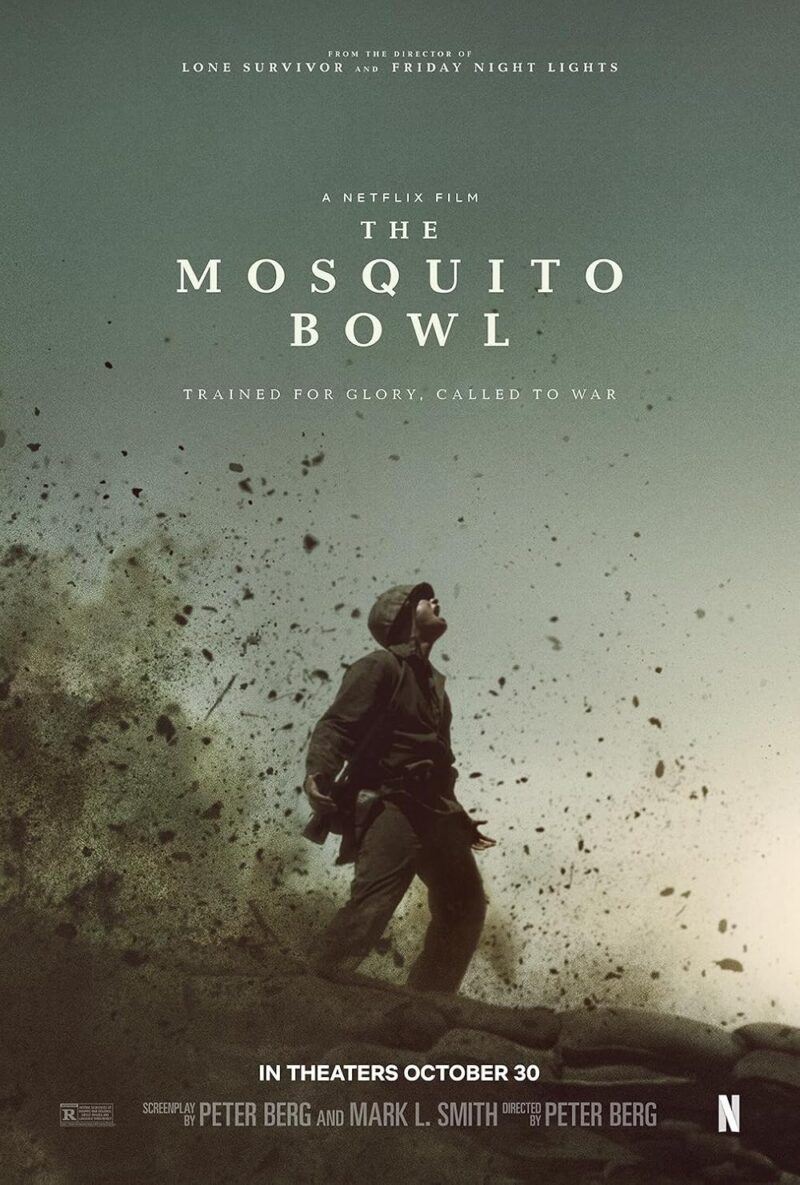
Having screened dozens upon dozens of World War II cinematic accounts over the decades, I often go into a historical war picture under the impression that every monumental story of the Greatest Generation has already been captured on celluloid. From the beaches of Normandy to the Ardennes, and from the skies over Europe to the atolls of the Pacific, Hollywood has surveyed almost every corner of the conflict. Yet, when Peter Berg’s adaptation of The Mosquito Bowl crossed our radar, it brought to light an extraordinary chapter of wartime brotherhood that, surprisingly enough, I had never encountered before.
For my wife and me, screening an early preview of this film was a deeply anticipated event. Beyond our mutual fascination with military history, it carried a distinct personal resonance: my wife served 11.5 years in the United States Marine Corps. When a movie steps onto holy ground—depicting the lineage, traditions, and brotherhood of the USMC—veterans and military households watch with a discerning eye. Berg’s film commands respect right out of the gate, grounding its epic scope in the raw, authentic realities endured by those who wore the Eagle, Globe, and Anchor.
The History: Leaving the “Safe Life” Behind
The narrative draws its foundation from Buzz Bissinger’s 2022 acclaimed historical work, The Mosquito Bowl: A Game of Life and Death in World War II. Following the devastating attack on Pearl Harbor on December 7, 1941, our nation was radically transformed overnight. Young men with promising futures across American life walked away from campus prestige, civilian comfort, and the cusp of athletic stardom to answer the call of duty.
Watching those young collegiate stars make that life-altering choice resonated deeply within our own home. Decades later, it was a similarly defining national tragedy—the attacks of September 11, 2001—that planted that same deep conviction in my wife, ultimately inspiring her to enlist in the United States Marine Corps in late 2011. Whether in December 1941 or the post-9/11 era, that selfless impulse to step forward when the nation is struck represents a timeless, unbroken thread of American service.
This theme of walking away from a life of security and privilege to serve on the front lines is also strikingly reminiscent of another upcoming historical project hitting theaters soon: Jimmy. That film chronicles Hollywood icon Jimmy Stewart, who, right at the peak of his box-office stardom and fresh off an Academy Award, walked away from the glitz of cinema to serve as a combat bomber pilot flying dangerous missions over the European Theater.
There is something profoundly noble and inspiring about stories like these—whether it is Hollywood royalty like Stewart or gridiron heroes trading their jerseys for uniforms. Choosing to leave a “safe life” behind when your country needs you most speaks to a rare caliber of character and selfless duty that today’s culture desperately needs to be reminded of.
At the core of The Mosquito Bowl are four stand-out collegiate football athletes from powerhouse programs—Purdue, Wisconsin, and Brown Universities—who bypassed professional aspirations to enlist in the Marine Corps. Brought vividly to life by an ensemble cast, Nicholas Galitzine (Masters of the Universe) portrays Brown standout and future pro fullback John McLaughry; Bill Skarsgard (It) stars as Wisconsin tackle Bob Baumann; Ray Nicholson (son of Hollywood legend Jack Nicholson) plays Purdue All-American and nation-leading scorer Tony Butkovich; and Tom Francis takes on the role of two-time Wisconsin All-American Dave Schreiner. These four men represent an entire generation of elite competitors who traded leather helmets for steel M1 helmets.
Before sending them into the Pacific, the film takes us through the crucible of Marine Corps Recruit Depot Parris Island. In a surprising casting choice that pays off with absolute conviction, ESPN host and former NFL punter Pat McAfee appears as a razor-tongued, hard-nosed Parris Island drill instructor. According to my Marine veteran wife, McAfee was remarkably convincing in the role, nailing the distinct posture, terrifying cadence, and unyielding psychological pressure that defines real-world recruit training.
The heart of the film’s title centers on a surreal, almost mythic historical event: Christmas Eve, 1944, on the island of Guadalcanal. As the 4th Marine Regiment and the 29th Marine Regiment (of the 6th Marine Division) staged in the Pacific preparing for what would become the bloodiest assault in the theater—the invasion of Okinawa—they orchestrated a full-contact, unpadded football game. Sixty-five collegiate athletes took the dirt field surrounded by an audience of thousands of their fellow Marines and soldiers.
It was a singular moment frozen in time. For a few bruising hours, the looming specter of combat was held at bay. The contest gave these young men a final, normal taste of the autumn afternoons they had left behind on American campuses, providing a fleeting pause from the misery of the jungle before destiny called them forward. Tragically, many of the men who traded tackles in that dusty Guadalcanal clearing would never make it back home, falling months later on the jagged ridges and sugar-cane fields of Okinawa.
Visceral Realism and Berg’s Signature Craft
Peter Berg, widely recognized for his mastery of gridiron intensity (Friday Night Lights) and uncompromising tactical warfare (Lone Survivor), is operating at the absolute peak of his capabilities. Merging these two storytelling disciplines could easily have felt disjointed in lesser hands, but Berg stitches them together seamlessly.
To bolster the film’s historical weight, Berg interweaves authentic period archival footage directly into the narrative tapestry. Seeing real wartime film reels—including appearances by USO legends like Bob Hope, his longtime sidekick Jerry Colonna, and singer Frances Langford entertaining troops—paints an authentic, era-accurate picture of life on the front lines.
When the film transitions into combat, it pulls no punches. The battle sequences are staggering in scale and uncompromising in their brutality, capturing the hell of the Pacific Theater with unflinching realism. Fans who revere cinematic benchmarks like Saving Private Ryan, The Thin Red Line, Dunkirk, The Bridge on the River Kwai, and Midway—as well as television milestones like HBO’s masterwork Band of Brothers—will recognize the craft and dedication to historical scale on display here. For audiences who appreciate character-driven sports films and authentic military cinema, The Mosquito Bowl offers a rare synthesis of both.
Faith, Brotherhood, and the Measure of Sacrifice
Beneath the tactical combat and gridiron collisions lies a profound moral core. Toward the latter portion of the film, a particularly moving scene features a military chaplain addressing a company of weary Marines, reminding them that even in the dehumanizing crucible of total war, they are to “give enemies a proper Christian burial.” It is a striking cinematic reminder of grace, dignity, and divine order pushed into the midst of unimaginable savagery.
While The Mosquito Bowl is not an overtly evangelistic faith-based film, the thematic undercurrent speaks straight to Scripture. The brotherhood, selflessness, and valor demonstrated by these Marines vividly illustrates the eternal truth recorded in John 15:13 (NIV), which says:
“Greater love has no one than this: to lay down one’s life for one’s friends.“
These young men had every reason to stay home, play the games they loved, and reap the rewards of athletic acclaim. Instead, they willingly stepped onto foreign soil, laid their bodies on the line, and died protecting the brother fighting next to them.
Parents’ Guide & Content Advisory
The Mosquito Bowl is rated R by the MPAA for intense sequences of graphic war violence, grisly images, and language throughout. Strong viewer discretion is advised:
-
Violence & Gore: The combat scenes are relentlessly graphic, brutal, and historically accurate to the horrors of island warfare in the Pacific. Depictions include deafening artillery bombardments, bodies riddled with high-caliber gunfire, combatants set ablaze by flamethrowers, severe traumatic amputations/severed limbs from explosive ordnance, and heavy blood and gore throughout.
-
Language & Profanity: There is pervasive, non-stop rough military profanity, including multiple uses of the ‘f-word’, throughout the film, including multiple instances where the Lord’s name is taken in vain. While reflective of the harsh, uncensored environment of combat infantrymen facing their own mortality in the Pacific mud, it is prominent and worth noting for sensitive viewers.
-
Appropriate Audience: This film is strictly geared toward mature adults and older teens who are prepared for the unvarnished, heavy reality of World War II combat. It is not suitable for children or younger viewers sensitive to severe violence or coarse language.
Final Thoughts
The Mosquito Bowl is a fantastic, gripping, and deeply moving cinematic achievement. Peter Berg has delivered not only an authentic, heart-pounding history lesson, but an enduring monument to the sixty-five men who played on Guadalcanal and the thousands who fought beside them. It honors those who gave their lives so that future generations could live in freedom. God bless our veterans, God bless the fallen, and Semper Fi to those who continue to bear the mantle of service.
4/5
^INTERVIEW WITH DIRECTOR PETER BERG
Released: 10/30/2026 (Theatrically) 11/25/2026 (Netflix)
Running Time: 127 Minutes (Netflix Studios)
Rated R for intense sequences of graphic war violence, grisly images, and language throughout.
Links for The Mosquito Bowl:
Directed by: Peter Berg
Starring: Nicholas Galitzine, Bill Skarsgård, Ray Nicholson, Tom Francis, Brent Comer, Dominic Bogart


Leave A Comment