
Written by: Mike Laxton (8/19/2026)
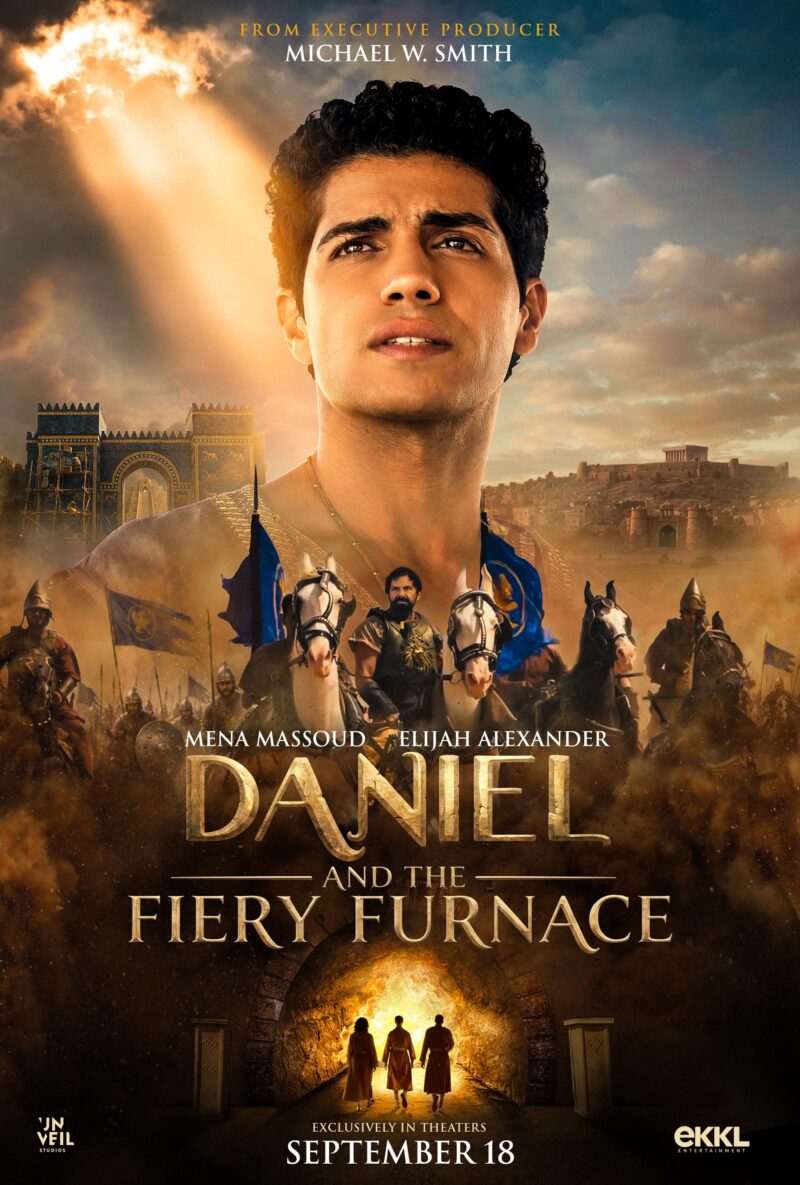
Starring Mena Massoud and Elijah Alexander, the new biblical epic delivers a powerful, visually impressive telling of Daniel’s early years in Babylon while never losing sight of the faith at the center of the story.
I recently had the opportunity to attend an advance screening of Daniel and the Fiery Furnace, and I walked away genuinely impressed.
There are faith-based films that tell a good story despite their limitations, and then there are films that simply feel like good movies that happen to be unapologetically rooted in faith. Daniel and the Fiery Furnace falls firmly into that second category.
Directed by brothers Matthew and Daniel Kooman, the biblical epic stars Mena Massoud — best known for portraying Aladdin in Disney’s live-action Aladdin — as Daniel, with Elijah Alexander of The Chosen delivering an imposing King Nebuchadnezzar. Michael W. Smith serves as executive producer, while his son, Tyler Michael Smith, composed the film’s score. The movie is scheduled to open exclusively in theaters nationwide Sept. 18 through EKKL Entertainment.
And after seeing it, Sept. 18 is a date I would encourage families and churches to put on their calendars.
A Babylon that feels real
One of the first things that struck me was the authenticity of the world the filmmakers created.
Rather than treating Babylon as little more than an exotic backdrop for a familiar Sunday school story, Daniel and the Fiery Furnace allows us to experience something of the enormity of what Daniel and his friends faced. They are young men ripped away from Jerusalem, carried into exile and suddenly surrounded by the wealth, power, religion and demands of one of the most formidable empires in the ancient world.
The Babylon we see feels massive, intimidating and lived-in. That sense of grandeur is fitting: archaeological evidence paints Nebuchadnezzar II’s Babylon as a city marked by monumental construction, including the famous Ishtar Gate and Processional Way with their elaborate glazed-brick imagery.
But the movie understands that the real battle isn’t simply between Jerusalem and Babylon.
It is a battle over identity.
Daniel arrives with Hananiah, Mishael and Azariah — the men whom Babylon eventually renames Shadrach, Meshach and Abednego. Daniel himself is given the Babylonian name Belteshazzar, just as Daniel 1 records.
Even Daniel’s Hebrew name carries significance: it means essentially, “God is my judge.” Later, Nebuchadnezzar himself acknowledges that Belteshazzar was a name connected with his own Babylonian god (Daniel 4:8).
That makes the theme beneath these early scenes especially powerful.
Babylon can change Daniel’s surroundings. It can teach him its customs. It can place another name upon him.
But Babylon cannot determine whom Daniel belongs to.
Faithfulness before the furnace
I appreciated that the filmmakers don’t race to the fiery furnace.
They spend considerable time establishing the convictions that will eventually make that moment matter.
Daniel and his friends are brought into the royal system and face pressure to conform to Babylonian expectations. The film dramatizes questions involving their status in the royal court and then arrives at the food placed before them.
The biblical foundation comes from Daniel 1:8, where Daniel resolves not to defile himself with the king’s food and wine. Daniel requests a different diet, and after a period of testing, Daniel and his friends prove healthier than those eating from the king’s table. More importantly, Scripture says that God gives these four young men knowledge and understanding, with Daniel receiving particular understanding of visions and dreams.
That becomes critically important when Nebuchadnezzar has a troubling dream.
The king’s wise men are faced with what appears to be an impossible task: Nebuchadnezzar doesn’t merely want an interpretation. He demands that they first tell him what he dreamed.
One of the movie’s more intense sequences demonstrates just how dangerous it is to disappoint this king. Parents of younger children should be aware that Nebuchadnezzar’s brutality is not merely discussed; there are moments that could be frightening or disturbing for especially young or sensitive viewers.
Eventually Daniel and his friends realize that their lives — along with the lives of Babylon’s other wise men — depend upon an answer no human wisdom can provide.
So they pray.
That is precisely where Daniel 2 places the emphasis. Daniel asks Hananiah, Mishael and Azariah to seek mercy from God concerning the mystery, and God reveals Nebuchadnezzar’s dream to Daniel.
The resulting sequence is one of the film’s most important.
Nebuchadnezzar’s dream reveals successive earthly kingdoms represented by the great image, but those kingdoms are ultimately overwhelmed by something greater. Daniel 2:44 declares that “the God of heaven will set up a kingdom that shall never be destroyed.”
For Christians, the significance is unmistakable. Human empires rise and fall. God’s Kingdom is eternal.
And Daniel does not take the glory for himself.
His faithfulness and God-given wisdom eventually elevate him within Nebuchadnezzar’s court, setting the stage for an even greater confrontation.
When standing becomes costly
The film takes some dramatic liberties in connecting the events of Daniel 2 and Daniel 3.
For example, the movie involves Daniel in the development of Nebuchadnezzar’s massive golden image, creating an interesting moral tension between carrying out responsibilities within Babylon and actually worshiping what Babylon worships. That particular involvement is not stated in the biblical text, nor are some of the film’s other action-oriented additions.
But rather than changing the central message of Scripture, most of those additions function as connective tissue between events.
The essential conflict of Daniel 3 remains intact.
Nebuchadnezzar demands worship.
Daniel’s three friends refuse.
And eventually the question becomes painfully simple:
Will they bow, or will they burn?
They choose the fire.
Scripture records that Nebuchadnezzar has the furnace heated seven times hotter than usual. The heat is so severe that the men charged with throwing Shadrach, Meshach and Abednego into the furnace are themselves killed.
Yet when Nebuchadnezzar looks inside, the three men he condemned are no longer bound.
And they aren’t alone.
Daniel 3 describes a mysterious fourth figure walking with them in the fire. Christians have long understood this scene as potentially portraying a pre-incarnate appearance of Christ, and Daniel and the Fiery Furnace fully embraces the wonder and emotion of that interpretation.
For me, this is where the film’s title sequence earns everything that came before it.
The spectacle is impressive, but the scene isn’t powerful merely because there is fire.
It is powerful because God is present in it.
Shadrach, Meshach and Abednego don’t discover a God who keeps them from every furnace. They discover a God who meets them inside one.
The emotion of that realization is allowed to breathe, and it becomes one of the film’s most moving moments.
Jeremiah, exile and hope
Another element I appreciated was the way the movie incorporates the prophet Jeremiah into its larger story of exile.
It’s important biblically to make the distinction that Daniel’s story comes from the Book of Daniel, not Jeremiah. But connecting the two prophets is hardly arbitrary.
Jeremiah sent God’s message to the Jewish exiles in Babylon, including the promise found in Jeremiah 29. Years later, Daniel 9 specifically tells us that Daniel was studying Jeremiah’s writings concerning the period of Jerusalem’s desolation.
That gives the film’s use of Jeremiah 29:11 additional weight:
“For I know the plans I have for you, declares the Lord…”
Placed in its proper setting, that isn’t a promise spoken to people experiencing comfortable circumstances.
It’s spoken in the context of exile.
That’s precisely why it belongs here.
The God who has a future for His people is still God when His people find themselves living in Babylon.
And then there is that ending…
There is one more thing I desperately want to talk about.
I’m not going to.
The film uses a storyteller to frame its account, and eventually we discover who is telling the story.
Do not let anyone spoil that for you.
I won’t reveal the identity, but I will say that the moment gave me goosebumps. My daughter was watching the screening with me, and watching the realization hit her may have been one of my favorite parts of the entire experience.
It’s the kind of reveal that works precisely because you don’t know it is coming.
Leave it that way.
A biblical epic worth seeing
Daniel and the Fiery Furnace isn’t a word-for-word visualization of Daniel 1–3, nor does it pretend to be. The Kooman Brothers use dramatic additions to create relationships, motivations and connective moments between events Scripture sometimes records very succinctly.
But the theological heartbeat of the biblical story remains unmistakable.
God is sovereign over kings.
God gives wisdom when human wisdom fails.
Earthly kingdoms do not last.
Faithfulness sometimes carries a cost.
And when God’s people find themselves standing in the fire, they are not abandoned there.
Massoud’s Daniel gives the audience a human entry point into those truths, while Alexander’s Nebuchadnezzar embodies the terrifying collision between absolute earthly power and a people who recognize a higher King.
I was also encouraged to see EKKL Entertainment behind the release. The faith-and-family entertainment company was founded by Michael Scott in partnership with Willie and Korie Robertson and Zach Dasher, with Daniel and the Fiery Furnace among its theatrical projects.
This is exactly the kind of biblical filmmaking I want to see more of: ambitious enough to feel cinematic, reverent enough to understand the source material and confident enough not to water down the reason these stories have endured for thousands of years.
I went into the screening hopeful.
I came out genuinely excited for people to see it.
Daniel and the Fiery Furnace arrives in theaters Sept. 18, and based on what I saw, I highly recommend experiencing this one on the big screen.
5/5
Released: 9/18/2026 (Theatrically)
Running Time: 108 Minutes (EKKL Entertainment)
Rated PG-13 for strong violence/bloody images.
Links for Daniel and the Fiery Furnace:
Directed by: Daniel and Matthew Koomon
Starring: Mena Moussad, Elijah Alexander, Zaki Ali







great movie – thanks